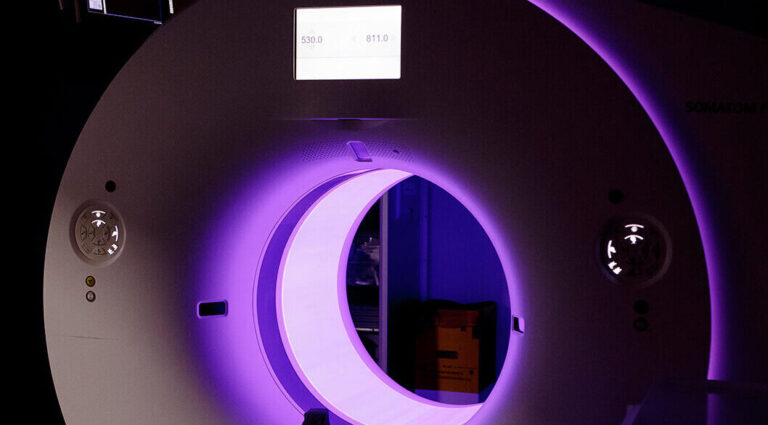

We may be living in the age of AI, but the human touch and collaboration by specialists are more important than ever.
At Paul Strickland Scanner Centre, cancer patients benefit not only from advanced imaging technology — made possible by the generosity of our donors and supporters — but also from the expertise of radiologists. One of those experts is Dr Subhadip Ghosh-Ray, Consultant Head and Neck Radiologist and Lead Consultant for Information Technology at the centre.
Dr Ghosh-Ray plays a vital role in multidisciplinary team (MDT) meetings, where specialists come together to plan treatment for complex cancer cases. His presence ensures that radiological findings are interpreted accurately and used effectively to guide decisions. He said: “Written words can be misinterpreted. That’s why I sit down with oncologists and radiotherapists to discuss each case face-to-face.” This collaborative approach is not common in many centres, where radiologists typically provide written reports without direct involvement in treatment planning.

“In many places, radiologists just write a report and that’s it. But our patients benefit hugely from having a radiologist in the room when their treatment is discussed.” Dr Ghosh-Ray attends weekly MDTs for melanoma, brain, and head and neck cancers at Mount Vernon and beyond. His input helps pinpoint tumour margins, identify hidden findings, and clarify complex imaging results. “It’s a bit of a necessary luxury. Most centres don’t have the time or resources for this, but we do — and it makes a real difference.”
‘Most centres don’t have the time or resources for this, but we do’
The impact of this work is amplified by recent upgrades to imaging technology and reporting systems at Paul Strickland Scanner – made possible by the generosity of our donors and supporters. We’ve changed the way we scan patients to make cancers easier to spot. “Our image viewing platform lets us switch between cases in milliseconds, which is a gamechanger if you’re interrupted midreport.”
Artificial intelligence (AI) is also beginning to play a role, particularly in improving workflow and our ability to scan more patients each year than ever before. The software makes our scanners faster at the same time as enhancing the quality of the images, meaning that patients have to spend less time in the scanner and we can serve more patients.
Looking ahead, Dr Ghosh-Ray sees potential in using MRI instead of PET-CT to monitor treatment response, which is particular pertinent given the issues with radiotracer currently experienced by centres across the UK. “PET-CT is time consuming and complex. If AI could help interpret MRI scans after treatment, we might be able to replace PET-CT altogether — but we’d need a proper trial to prove it.” To make that vision a reality, a dedicated internal AI research group could be set up. “We have individuals doing great work and a coordinated effort would really move things forward.”
For now, patients at Paul Strickland Scanner Centre continue to benefit from a rare combination of cuttingedge technology and expert collaboration — with Dr Ghosh-Ray and his colleagues’ ontributions at the heart of it all.