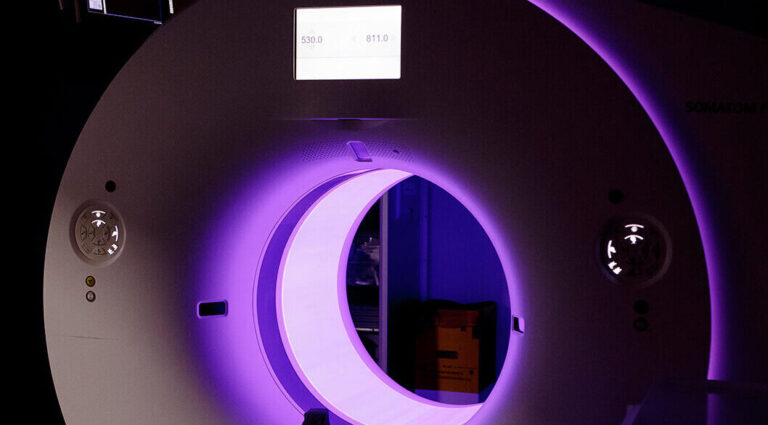

As awareness of whole-body MRI grows, more people are exploring whether it could provide reassurance or clearer answers about their health. This scan can be beneficial when concerns fall outside screening programmes, or where there is a family history of cancer.
This article explains why whole-body MRI is used, what it can and can’t show, and how results are interpreted and followed up.
The benefits of a whole-body MRI scan
Many people choose a whole-body MRI to help reduce uncertainty about their health. The scan provides a detailed overview of much of the body in a single appointment, helping doctors determine whether anything needs further investigation.
By looking at multiple areas at once, whole-body MRI can be particularly helpful when symptoms are unclear or when someone wants a broader picture of their health.
No ionising radiation
A whole-body MRI uses magnetic fields and radio waves to create detailed images. Unlike some other types of scans, it doesn’t involve ionising radiation, which can be harmful. For people who are cautious about repeated medical imaging, this can feel like a reassuring option, particularly if they’ve had previous scans or anticipate needing monitoring in the future.
Advanced AI-enabled imaging for quality and comfort
Whole-body MRI at Paul Strickland Scanner Centre uses artificial intelligence (AI)-assisted imaging technology to enhance image clarity while helping to reduce scan time. By refining how images are reconstructed and processed, AI technology supports consistent image quality and can make the experience more comfortable for patients.
Informed by ongoing clinical research
Our specialist radiographers and consultant radiologists are actively involved in national and international research focused on improving cancer imaging and reporting standards. This work helps refine how scans are performed, interpreted and followed up, with a strong emphasis on patient care and outcomes.
By contributing to the development of evidence-led approaches, including those adopted within the NHS, we aim to ensure that patients benefit from imaging that is carefully evaluated and continually improving.
Designed to identify possible signs of cancer
Whole-body MRI is designed to look for signs of cancer across multiple organs and systems. For many people, peace of mind is the main benefit. A clear result can help ease worries and reduce ongoing anxiety about their health.
Where something unexpected is found, the scan can also help guide timely and appropriate follow-up, so that any necessary next steps are taken in a considered and supportive way.
How whole-body MRI is different from routine screening
Routine screening programmes are designed to look for a single type of cancer in large groups of people. Decisions about who is invited for screening, and at what age, are based on evidence of population benefit, cost and practicality.
As a result, many cancers do not have an established screening test. Even where screening exists, a significant number of cancers are diagnosed outside these programmes, often because not everyone who is eligible takes part.
A whole-body MRI sits in a different space. Instead of focusing on one organ, it looks across much of the body in a single scan, using a technique that does not involve ionising radiation. It is usually considered on an individual basis and is aimed at providing personal peace of mind, rather than population-wide screening.
This approach is sometimes described as opportunistic early detection, meaning it looks for possible signs of cancer before symptoms develop.
Importantly, whole-body MRI is not intended to replace established screening tests such as mammography, bowel screening or cervical screening. These tests remain the most effective ways to detect certain cancers at specific sites. Whole-body MRI can sit alongside them, offering a broader overview when reassurance or additional clarity is the main goal.
What whole-body MRI can and cannot show
A whole-body MRI can detect changes across many parts of the body, which makes it especially helpful when a fuller picture of health is needed.
It’s particularly useful for identifying:
- Changes in bones, soft tissues (like muscles) and major organs
- Cancers that don’t have established screening programmes, such as pancreatic cancer
That said, no scan can show everything. It’s important to understand the limitations as well as the benefits. For example:
- Very small or very early cancers may not always be visible
- What the scan can detect depends on the type, size and location of a condition
- Some areas of the body, such as the bowel, breast or skin, are often better assessed with targeted tests
For this reason, whole-body MRI works best as part of a wider picture, rather than as a stand-alone solution. It isn’t designed to provide absolute certainty about every possible cancer. Instead, it offers a clear overview that can either help reduce uncertainty or help guide your pathway.
How findings are assessed and managed
Whole-body MRI is a highly sensitive test, which means it can pick up a wide range of changes across the body. It is common for people to have at least one finding on their scan. In most cases, these findings are benign – not harmful and not linked to cancer. What matters most is how each finding is assessed and how any next steps are managed.
At Paul Strickland Scanner Centre, whole-body MRI scans are reported using a structured and consistent approach. This helps radiologists assess how likely a finding is to be significant.
Findings are grouped according to their level of concern, from normal or clearly benign changes through to those that may need closer attention. This system supports decision-making, helps avoid unnecessary tests and ensures that anything concerning is followed up appropriately.
Some findings are described as likely benign. While this wording can understandably feel unsettling, it usually means that the chance of cancer is low and that further imaging is suggested simply to confirm this.
A smaller number of findings may appear more suspicious and require referral to a specialist or additional tests. Where this happens, clear guidance is included in every report, so you’re supported and not left to interpret the results on your own.
Why choose Paul Strickland Scanner Centre for your whole-body MRI?
Whole-body MRI is most effective when it’s performed and interpreted by teams with specialist experience in cancer imaging. At Paul Strickland Scanner Centre, scans are carried out in a dedicated clinical setting with a strong focus on quality, safety and clear follow-up steps.
Cancer-specialist expertise
The centre is located at Mount Vernon Cancer Centre. This means scans are interpreted in a cancer-specialist environment, with clear guidance given, should further investigation be needed.
Whole-body MRI at the centre is led by Professor Anwar Padhani, an internationally recognised specialist in cancer imaging. His clinical and research work has contributed to shaping how whole-body MRI is performed and reported in practice.

Dual consultant reporting
Whole-body MRI scans are independently reviewed by two consultant radiologists with expertise in cancer detection. This dual reporting approach supports careful interpretation and reduces the likelihood of both missed findings and unnecessary concern.
Clear, consistent reporting you can understand
Scan results are assessed using a recognised scoring system that helps doctors judge how likely a finding is to be significant. This brings consistency to reporting and helps determine your way forward. If something is identified, you’ll receive clear advice about what it means and whether any further action is recommended.
Established research and clinical standards
The centre is actively involved in clinical research that helps improve how cancer imaging is performed and interpreted. Whole-body MRI scans are delivered using approaches shaped by current evidence and established professional guidance.
Designed with patient comfort in mind
Scans are typically completed within 45 to 60 minutes and use wide-bore MRI technology designed to support comfort. Specialist radiographers are present throughout to provide support and clear communication. Feedback from our patients frequently highlights the professionalism of the team and the supportive, comfortable environment throughout the scanning process.
Book your whole-body MRI scan today
If you’re considering a whole-body MRI scan, you can book directly online at a time that suits you. If you’d prefer to speak to someone first, our team is here to answer your questions and help you decide if it’s the right next step.
To find out more or to book your scan, please complete our online registration form.