By giving trainee radiologists time, experience and expert support, we prepare the next generation of consultants
When Dr Amish Lakhani was choosing his medical speciality in the early 2010s, radiology stood out because of the pace at which it was changing. New scanner technology, increasingly sophisticated software and, more recently, artificial intelligence are all transforming the way radiologists provide care. But technology was only part of the attraction. Cancer imaging also
offered Dr Lakhani the opportunity to use his medical knowledge across the whole body.
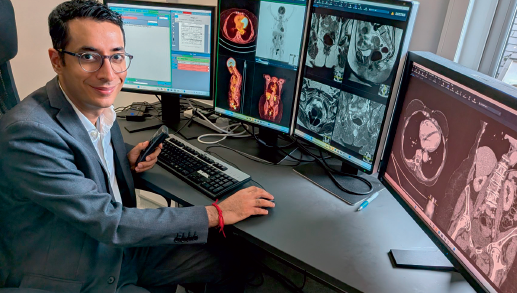
“Cancer patients can have tumours which spread across different parts of the body. Radiology allows us to give a holistic view of what is happening to that patient and helps guide the oncologist in managing their care,” he says. Today, Dr Lakhani is a consultant radiologist and leads radiology training at Paul Strickland Scanner Centre. Having once trained at the centre himself, he understands the difference that a supportive learning environment can make.
Time to learn thoroughly
Clinical radiology speciality training typically takes five years. During their first three years, doctors complete core training which focuses on general radiology foundation and subspeciality attachments (such as chest, neuro and urogenital). During their final two years, trainees then choose to develop specialist expertise in fields such as oncological imaging.
The centre welcomes trainees from hospitals and training schemes across London, Hertfordshire and the east of England. Depending on their stage of training, they may spend several days a week at the centre, with as many as five or six trainees attending during the course of a week.
‘We have to work with AI and implement it into our workflow’.
What they encounter is very different from the pressured environment of an acute hospital. As a specialist cancer imaging centre, Paul Strickland Scanner Centre gives trainees experience of advanced techniques, including PET -CT and whole-body MRI, as well as the opportunity to contribute to multi-disciplinary team meetings in which specialists plan patients’ care.
The predominately outpatient environment also gives trainees something especially valuable: uninterrupted time to study scans carefully and understand each patient’s cancer journey. “I always advise trainees not to rush their reports. I suggest they make the most of the unique opportunity we offer by taking their time, reviewing previous scans carefully to work out how the cancer is behaving in each patient, and formulating the best report they can to help guide the oncologist to offer the optimal treatment for each patient. I want them to spend their time learning thoroughly,” says Dr Lakhani.
The experience clearly makes an impression. According to Dr Lakhani, almost every trainee doctor who attends for a core rotation asks whether they can return later as a senior trainee. Many eventually do.
More than reading scans
A good radiologist needs an inquisitive mind. Dr Lakhani compares the work to being a detective: bringing together a patient’s medical history, symptoms, blood results and imaging to reach a useful conclusion.
Although radiologists may not always meet the people whose scans they examine, their work is central to each patient’s care. Reports must do more than describe what appears on an image. They must give oncologists and other clinicians the information they need to make treatment decisions.
Training is carefully tailored to each trainee’s experience and ambitions. Trainees agree learning objectives, take part in workplace-based assessments and receive feedback throughout their placement. Their progress may be assessed through scan reports, teaching sessions or their preparation and presentation of cases at multi-disciplinary meetings.
‘The future of clinical radiology is in very good hands’.
Delivering this training programme is a team effort. Clinical supervision is supported by colleagues who arrange contracts, IT access, information governance and mandatory training, often beginning preparations months before a trainee arrives. An induction manual also helps trainees understand their placement and its expectations in advance.
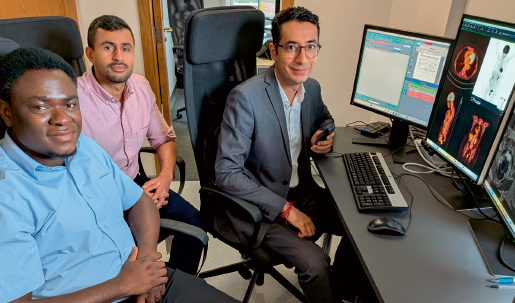
Khan in our radiology reporting suite.
Preparing for an AI-enabled future
The way radiologists learn is changing alongside the profession itself. Remote working is now more common, so teaching can include virtual discussions, online feedback and Teams calls to examine interesting cases together.
Artificial intelligence is likely to play an increasingly important role too. Potential uses include improving scan quality, helping identify abnormalities and prioritising urgent cases. However, Dr Lakhani believes AI will change radiologists’ work rather than replace them. “We have to work with AI and understand how to implement it into our workflow. The current trainees are very technology and AI -literate. The future of clinical radiology is in very good hands.” Testing and improving these systems takes time, just as training a doctor does. In both cases, the initial investment can produce lasting benefits: better-quality reports, more effective teams and, ultimately, better-informed care. Support that builds a lasting legacy Supporters often help fund advanced scanners and other technology, but investment in education is equally important. Subscriptions to specialist anatomy software, access to cancer-imaging courses and other educational resources all help trainees and established consultants maintain and develop their expertise.
“Training is investing in the future. One day, it will be the next generation taking our speciality forward,” says Dr Lakhani.